
Le Fromager, tree of life and sacred tree
The Cheese Tree
The Cheese tree is on the emblem of Nicaragua, as a tree of life for many ancestors.

In Spanish, its name is ceiba. It was a very sacred tree for the Maya, during the classical period (300-900). It symbolized the axis of the world, the axis mundi.
The Cheese tree is considered a tree of life; its seeds contain up to 25% oil. The wool surrounding the seeds, called "kapok" is composed of fibers with a cottony consistency welded together with a remarkable buoyancy. In the past, these fibers were used to make life jackets or to fill cushions or mattresses. The bark of Fromager is used in traditional medicine, it is a powerful diuretic.
The root is reputed to be an appetizer, and the green leaves are recommended as a friction against hair loss.
Nowadays, the Fromager is mainly used in leaf bath, in association with other medicinal species, in the treatment of the bourbouille and the superficial cutaneous disorders.
The Fromager, a sacred tree
A strong mysticism surrounds the Fromager. Indeed, this tree is considered sacred and gives rise to many superstitions in the West Indies. It is therefore protected and respected. Indeed, some consider that this tree is inhabited by spirits (Zombie Tree).
Remarkable tree, the Fromager occupies a place of choice in the popular beliefs. It should not be cut when it is alive under penalty of curse and its high branches would serve as a refuge for creatures of the night.
The Caribbean Indians rarely used the cotton of the Fromager because according to the legend their sleep would have been haunted by it.
The Fromager in Martinique
You can find this tree in all Martinique, and mainly in the north, in the Tropical Forest.
You can observe it for example, on the heights of Saint-Pierre, or during hikes in the center of Martinique, towards the Morne Rouge and the Morne Vert.
In the south, in the forest of Montravail, above Sainte Luce, a stage of hike is precisely the observation of a Fromager of more than 45 meters.
To discover Martinique, we advise you to rent a car. It will be easier for you to stop according to your desires and your favorites. Take the time to observe the landscapes, to stroll on a beach, to rest under a carbet or to go to your activities and leisure.
Source image : https://www.bellemartinique.com/la-martinique/mer-nature/flore/le-fromager/
The kapok tree (Ceiba pentandra), known as the fromager in the French Caribbean, is one of the most impressive trees you can see in Martinique. Recognisable by its imposing trunk and remarkable size, this tropical tree can grow several dozen metres tall.
Also known as the kapok tree, it stands out for more than just its appearance. Its fruits produce kapok, a natural fibre with many uses, while the tree also holds a special place in various Caribbean beliefs and traditions.
Pour l'anglais, j'ai volontairement privilégié “kapok tree” plutôt qu'une traduction littérale de fromager, puisque c'est le terme anglais utile pour identifier Ceiba pentandra.
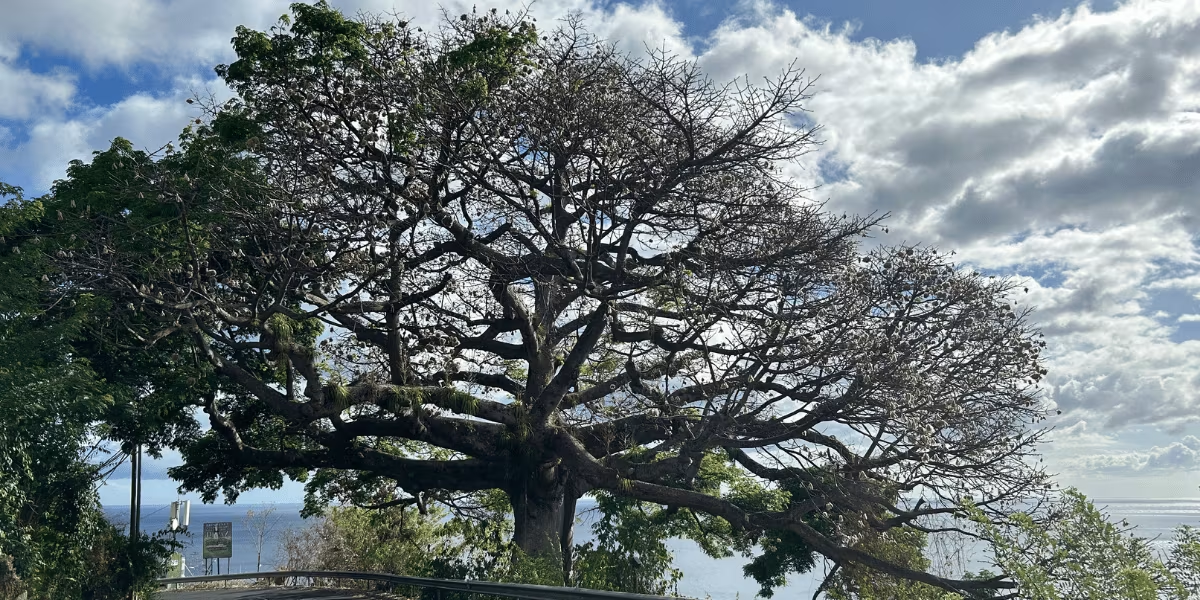
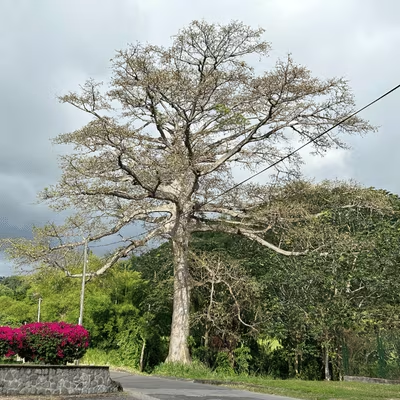
The Croix Louisy kapok tree in Saint-Pierre, listed as a remarkable tree in Martinique.
What is the kapok tree?
The kapok tree, known as the fromager in the French Caribbean, is a large tropical tree native to tropical America. Found throughout the Caribbean, including Martinique, it is recognisable by its imposing trunk, often supported by large buttress roots, and can grow several dozen metres tall.
Scientific name: Ceiba pentandra
Other names: kapok tree, silk-cotton tree
Origin: Tropical America
Height: up to approximately 60 m when mature
Trunk feature: young trees can have spines on their trunks.
Flowering season: generally in January and February in the Caribbean, before the new leaves appear.
Fruiting: the fruits, in the form of capsules containing seeds surrounded by a plant fibre called kapok, mature a few months later, particularly in April and May.
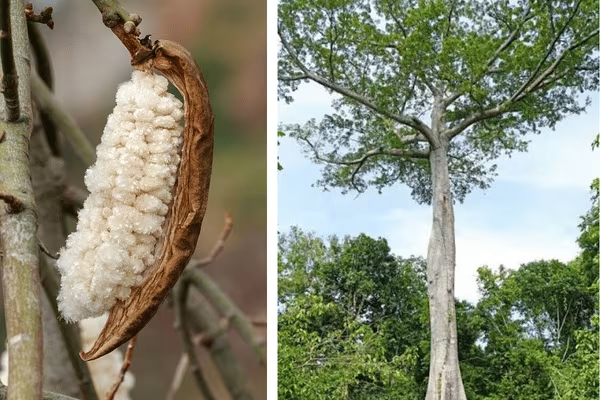
The kapok tree is a large tropical tree whose fruits contain a plant fibre known as kapok.
What Is the Kapok Tree Used For?
The fruit of the kapok tree contains a lightweight plant fibre called kapok, which surrounds its seeds. In Martinique, this fibre was traditionally used to fill mattresses and pillows.
Elsewhere, kapok has also been used to make cushions, flotation equipment such as life jackets and lifebuoys, and as an insulating material.
The Kapok Tree: An Tree Surrounded by Caribbean Beliefs
Beyond its natural characteristics, the kapok tree holds a special place in Caribbean beliefs and folklore. Imposing and sometimes regarded as sacred, it is notably associated with spirits and the supernatural in various Caribbean traditions.
These beliefs have helped make the kapok tree both respected and sometimes feared, surrounded by stories and legends passed down through generations.
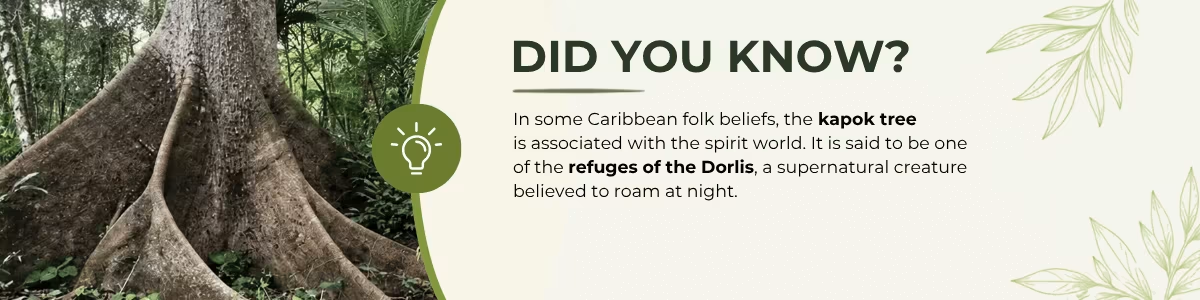
In some Caribbean folk beliefs, the kapok tree is associated with the spirit world and the Dorlis, a supernatural figure from Martinican night-time folklore.
Where can you see remarkable kapok trees in Martinique?
Several remarkable kapok trees can be found across Martinique. Some stand out for their impressive size, age or history and form part of the island's natural heritage. Here are a few notable specimens to discover during your stay.
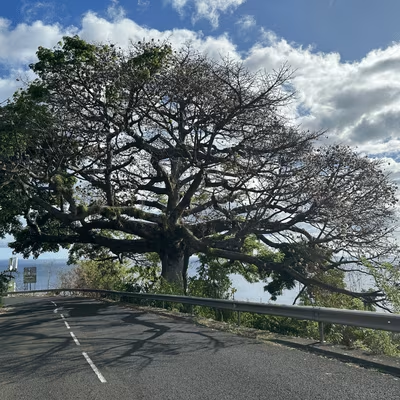
The Croix Louisy kapok tree in Saint-Pierre
Located below the road connecting Saint-Pierre and Fonds-Saint-Denis, this majestic kapok tree overlooks the town and bay of Saint-Pierre. Listed by the CAUE as a remarkable tree in Martinique, it is said to have been completely scorched during the 1902 eruption of Mount Pelée. Buds and leaves reappeared around fifty years later, and the tree has continued to grow ever since.
The kapok tree at Habitation Depaz in Saint-Pierre
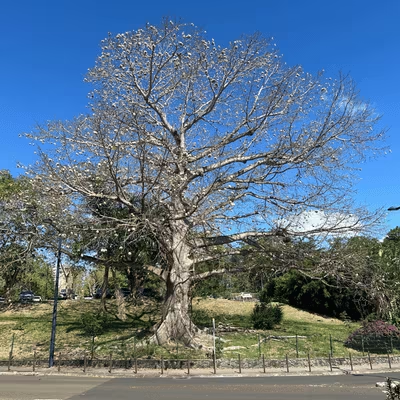
At the entrance to Habitation Depaz, an imposing kapok tree welcomes visitors in a setting steeped in the history and heritage of Saint-Pierre. Its impressive silhouette and size make it a particularly interesting specimen to observe when visiting the estate.
The Cluny kapok tree
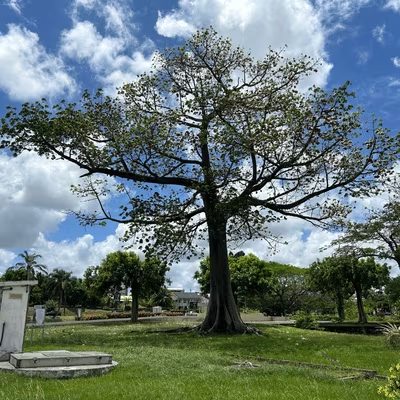
In Cluny, another specimen stands out for its imposing silhouette and broad branches. Visible from the road, it offers another example of the kapok trees that can be encountered while exploring Martinique.
The Place d’Armes kapok tree in Le Lamentin
Another imposing kapok tree can be seen in the Place d’Armes neighbourhood of Le Lamentin. Its broad trunk and towering silhouette offer a striking example of the impressive size this tropical species can reach.
Other remarkable kapok trees can also be found across the island. In Bassignac, La Trinité, the kapok tree known as “Ayya” represented Martinique in the national Tree of the Year competition.

Continue Exploring Martinique
Would you like to see a kapok tree during your stay? Montravail Forest, in the hills above Sainte-Luce, is one place where you can spot one during your walk. Continue your journey by exploring other natural and cultural sites and discovering more about Martinique’s landscapes, traditions and heritage.
Hiking in Montravail Forest in Sainte-Luce
Discover Montravail Forest in Sainte-Luce, its hiking trails, tropical vegetation and Amerindian rock carvings.
Bois Lélé in Martinique
Discover bois lélé, a distinctive star-shaped wooden stirrer traditionally used in Martinique to mix drinks and prepare ti-punch.
Quimbois in Martinique
Have you ever heard the expression “Sé an tjenbwa”? Discover the origins of quimbois, its heritage and the beliefs that continue to shape Martinican culture.
Tropical plants, colourful flowers, palm trees and suspended walkways: discover the Jardin de Balata and plan your visit to one of Martinique’s most iconic gardens.

Sign up for our newsletter
And receive our promo codes and exclusive car rental offers in Martinique, delivered straight to your inbox.


